Loan sharks do not publish rate sheets, but court cases and consumer reports show a consistent pattern: interest quoted by the week, commonly in the range of 10 to 20 percent, with no cap on what the debt can become. This page shows what those numbers actually mean in dollars, and how they compare with legal borrowing.
Why weekly interest is the tell
Legal lenders must disclose an annual percentage rate, which lets you compare loans. Loan sharks quote by the week because small weekly numbers sound harmless. Twenty dollars a week on a hundred dollar loan sounds manageable. Said honestly, it is 20 percent per week, which compounds to an annual rate in the thousands of percent.
A worked example
Suppose you borrow $500 at 20 percent weekly interest, and the lender expects $100 each week as the interest payment, with the $500 still owed at the end.
| Time paying | Interest paid | Still owed |
|---|---|---|
| 4 weeks | $400 | $500 |
| 12 weeks | $1,200 | $500 |
| 26 weeks | $2,600 | $500 |
| 52 weeks | $5,200 | $500 |
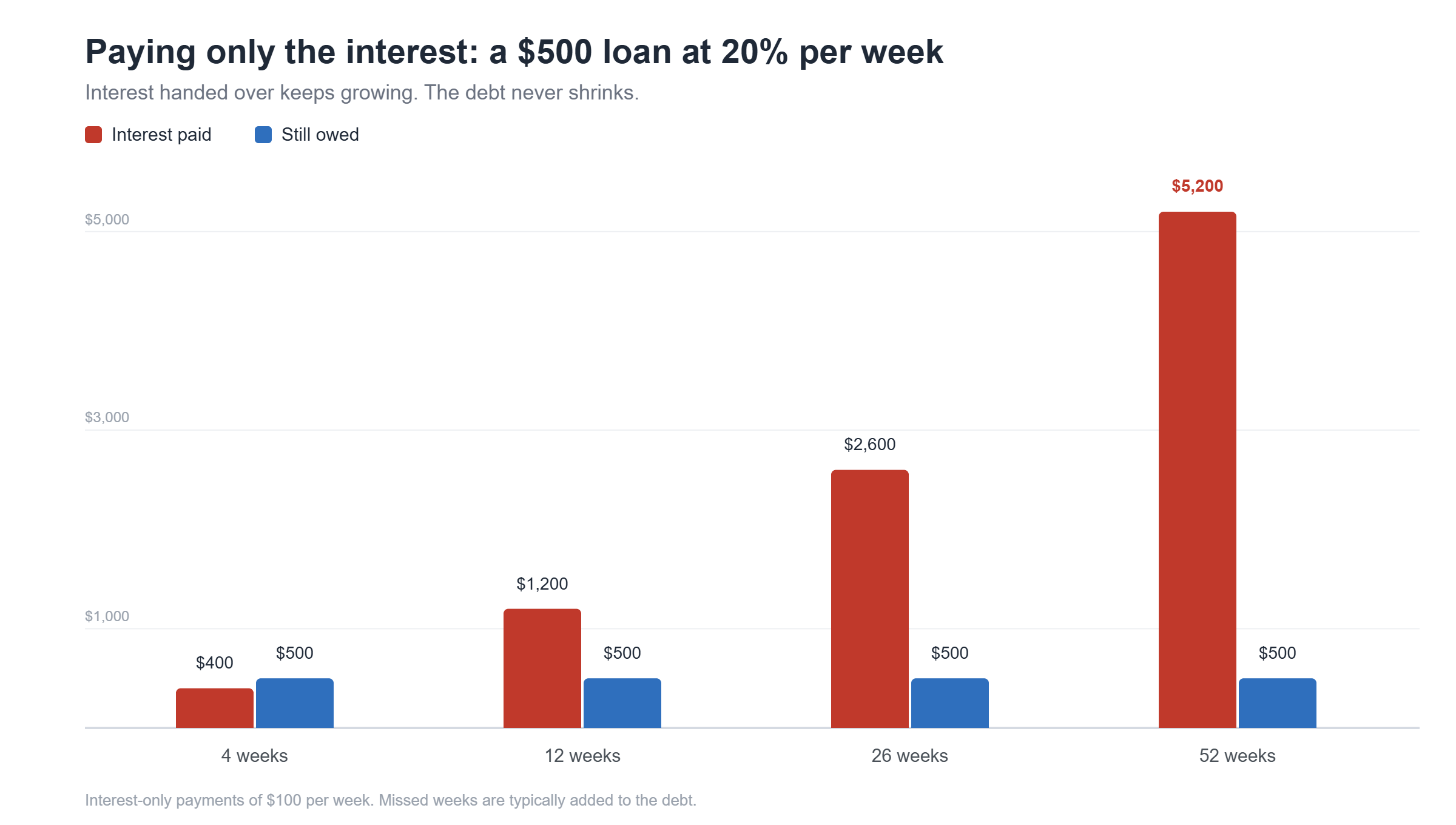
After a full year you have paid more than ten times what you borrowed and the debt has not shrunk by a dollar. Miss a week and many lenders add the missed $100 to the principal, so the weekly interest rises to $120. This is the treadmill described in how loan sharks work.
How that compares with legal borrowing
| Source of money | Typical annual rate |
|---|---|
| Credit union payday alternative loan | Capped at 28% |
| Credit card | Roughly 20% to 30% |
| Subprime personal loan | Roughly 30% to 36% |
| Payday loan (where legal) | Often around 400% |
| Loan shark at 20% per week | Over 1,000%, uncapped |
Even the most criticized legal product is dramatically cheaper than a loan shark, and a legal lender cannot rewrite the terms, seize your ID, or threaten you. If you are comparing options because you need cash now, our guide to alternatives ranks the safer choices.
Is there a legal maximum interest rate?
Yes. Most U.S. states have usury laws that cap interest on consumer loans, with the cap varying by state and loan type. A lender charging above the cap without a license that permits it is breaking the law, and in many states some or all of the loan becomes unenforceable. More on that in are loan sharks illegal?
If you are already paying rates like these
To run your own numbers, use our loan shark debt calculator. Stop and get advice before the next payment. You may not legally owe what the lender claims, and free confidential help exists. Start with how to get out of loan shark debt or go straight to the organizations on our debt help page.
Figures above are illustrative examples, not quotes. This page is general information, not legal or financial advice. Last reviewed August 2026.